

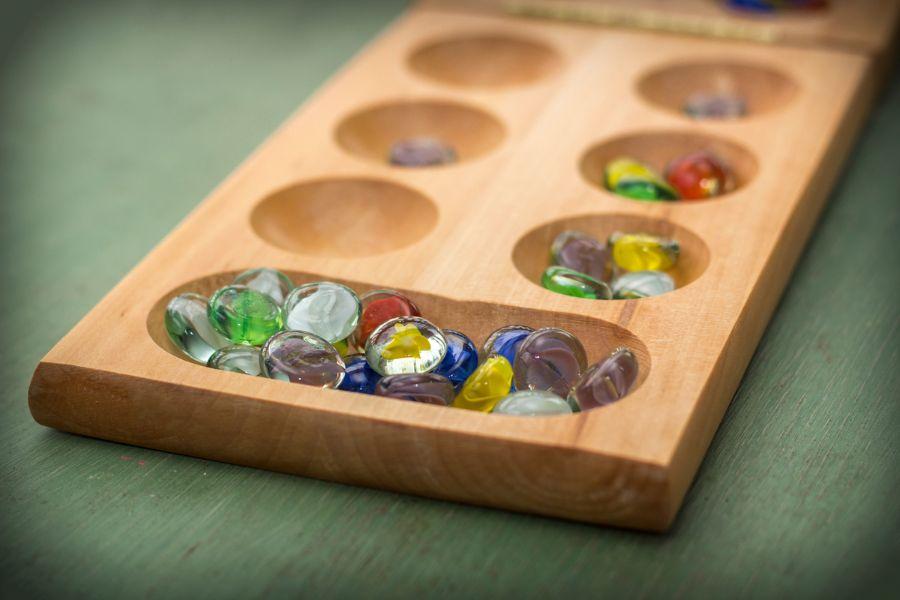
Some authors call Mancala, not a specific game, but the whole family of ancestral games of “pits and pebbles” in which “seeds are sown and collected”.
In this page we explain the rules of the most widespread Mancala in the western world, which many call directly Mancala or Kalaha.
It is an ancient game. Our ancestors were already having fun and challenging each other with Mancala games thousands of years ago. And for that reason alone it deserves this space on our website.
In fact, it was the first game we published in LOODENS and we have a special affection for it. It was, and is, our tribute to that anonymous homo sapiens who one day decided to dig some holes in the ground, took some seeds, and invented a game to enjoy his leisure time intellectually challenging a colleague. A crack. Like all those who invent something or do something for the first time in history.
We encourage you to discover and practice it!
How to play Mancala
Set up

Players
Mancala is a 1 vs. 1 game, so two players are required.

What you need to play
The game is played with a special board on which there are holes (or cups) through which the game pieces move.
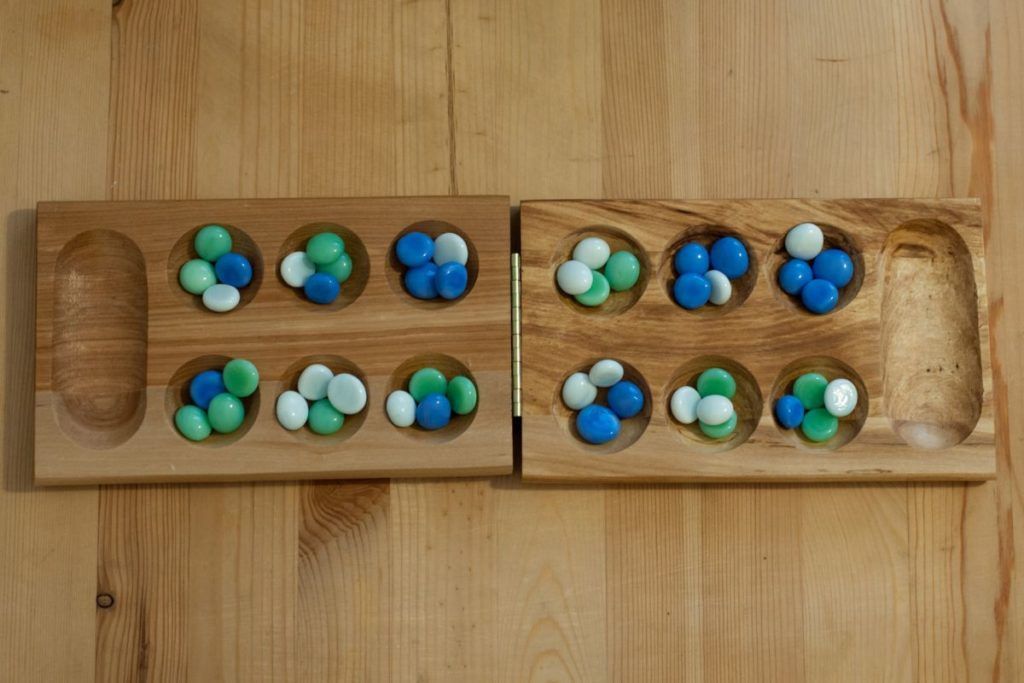
48 small pieces are used to simulate seeds that will be sown in the 12 small holes (holes or cups) and in the two large holes (stores or cups of points).
You can improvise a homemade version of Mancala with objects you have at home, although there are Mancalas on the market at very good prices. Below we offer you a guide and tips for both.

Understanding the Mancala board
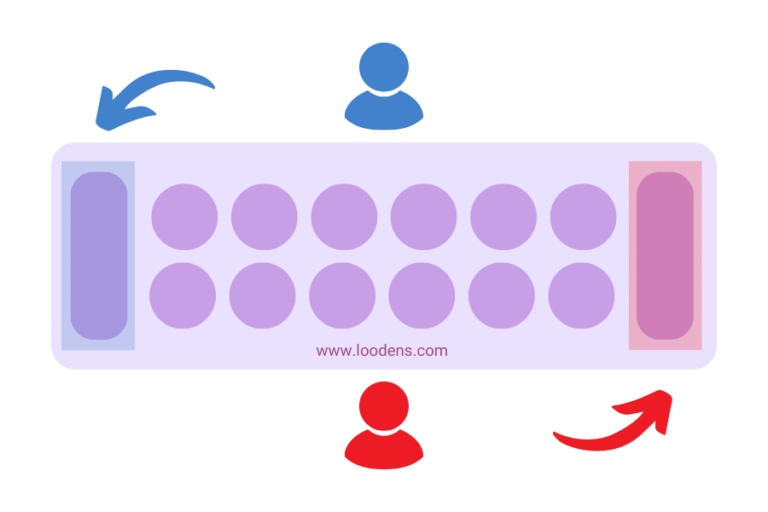
Each player is associated with one of the groups of 6 holes on each side of the board. The large hole to the right of each player will be his or her storehouse or point hole.
Hole zones belonging to each player:

Store or hole of points of each of the players:
Starting position
Four pieces are placed in each of the 12 small holes.

How the pieces move
The pieces will circulate counterclockwise and, little by little, will fall into the warehouses, giving points to each player. Then we see the rules.


How the pieces move
The player with the least experience playing Mancala starts.
Goal of the game

What you need to do to win
Wins the player who has the most pieces in his storehouse at the end of the game.
Mancala rules: playing a mancala game

This is how a shift is played
The player whose turn it is chooses one of the holes on his side that is not empty. He takes the pieces that are in it and leaves them one by one in a counterclockwise direction (to the right) from the next hole until there are no pieces left in his hand.

The stores
- If he passes by your warehouse, he also leaves a piece there, adding a point.
- If it passes through the other player’s warehouse, it is skipped.
Here are some examples:
Example 1
Let’s assume that the red player has the turn and chooses the hole with the red colored pieces.

This is how the pieces would look like after their movement:

Example 2
In this other example, the red player chooses the hole with 9 pieces:

This is how the pieces would look like after their movement:

As you can see, nopieces are left in the opponent’s warehouse!
Mancala special rules

Rule 1 – Extra shift
If the last piece falls in your warehouse you get an extra turn, very important!
Example 3
If the red player selects the pieces colored in red…

… the last piece will fall into your warehouse.

This gives you an extra turn. He will then choose again a hole on his side to make a new move, very important at a strategic level!
Rule 2 – Capture of pieces
If the last piece lands in an empty hole on your side then you capture that piece and any pieces in the hole directly opposite of the opposing player and take them to their storehouse.
Example 4
If the red player chooses the hole with the red-colored pieces…

…the last piece falls into a hole in his area that was empty.

Capture then that last piece and the other player’s pieces on the opposite side.

And he takes them to his warehouse !

This is one of the key strategies to win a game of Mancala!
Rule 3 – You can’t change your mind
Once the pieces have been taken from a hole, it is mandatory to play with them. It is not allowed to change the play in the middle of the game.

Next turns
Players will alternate turns following the dynamics and rules explained above.
Game over – And the winner is…

End of game
The game of Mancala ends when all 6 holes in either player’s zone are empty.

And the winner is…
The winner is the player who has collected the most pieces in their storehouse.
Mancala Playing Tips

Tip 1 – Alternate who starts
The player who has the first turn enjoys a slight advantage so the game will be fairer if several games of Mancala are played and alternating who starts.
Tip 2 – Train
Mancala games are faster and easier if played with fewer pieces. We recommend starting with 2 or 3 pieces per hole instead of 4 in the first games, especially for children.
Tip 3 – Limit time per shift
If a player takes too long to make a move, it’s a good idea to agree on a time limit per turn. If you overshoot that time, you lose your turn.
How to create a home-made version of Mancala
The pieces
An infinite number of small objects can be used as parts: pebbles, marbles, chickpeas, beans, small coins, buttons, small seashells…
All you have to take into account is that they are easy to handle, that they can fit up to 10 pieces in the same hole and that 48 pieces are needed!
Small holes
Coffee cups, egg cups, small bowls… can be used as small holes.
You can also draw some circles on a large piece of paper and even, if you are in the street, dig the holes in the sand.
The stores
A bowl, a glass, a plate, a small box… can be used for storage. The power of imagination!

Buying guide and tips
For a better playing experience we recommend purchasing a Mancala board.
Especially if you have already tried the game, liked it, and know that you will play it many times.
Aspects to be considered
There is no such thing as “the best Mancala” because not everyone has the same needs, nor the same expectations, nor will we all use the game in the same way.
Everyone must find “their best product” taking into account these variables:
1 – Playing comfort
The size of the holes and the size of the pieces must be coherent and proportional to each other so that taking the pieces when a hole is full does not become an odyssey, the pieces fall out or end up in other holes. For us it is the most important aspect to take into account because the playing experience will be uncomfortable if only 5 or 6 pieces fit in a hole. Please keep this in mind.
2 – Resistance and quality of materials
The Mancala board can be made of wood or plastic of different qualities. And there is even more variety when we talk about the pieces that can be made of wood, glass, stone, minerals, plastic…
Depending on the use we are going to give to the game – it will not be the same to play occasionally once or twice a year than to play regularly every week – we will have to acquire a product that is presumed to be more or less resistant to use.
On the other hand, we will have to evaluate if a simple plastic mancala is enough for us or if we want one made of noble wood that is also carved and decorated as if it were the throne of a king because in that sense there are for all tastes and for all pockets.
3 – Space it takes up
The larger the Mancala board, the more comfortable it is to play. But do not forget that it will have to be stored somewhere afterwards. We must take into account the storage space available when choosing a larger or smaller model, folding or non-folding.
4 – Portability
If we plan to take our Mancala out for a walk, perhaps to play at a family member’s house, or to challenge a friend in a bar, or as a travel companion to liven up the waiting hours at an airport, we will have to consider buying a Mancala that is light and easily transportable.
Where to buy a Mancala
Full transparency: some of the products we recommend include affiliate links. If you buy through them, we get a small commission — at no extra cost to you. Thanks for your support!
You will find Mancalas in specialized board game stores, although the best prices and discounts are usually on Amazon.
We recommend the best ones below:
Simple and portable mancala
This is the “classic” Mancala, the one that never fails. A wooden board that folds shut like a hinged box: you store the pieces inside and take it wherever you want, just as good at home as tucked into a suitcase.
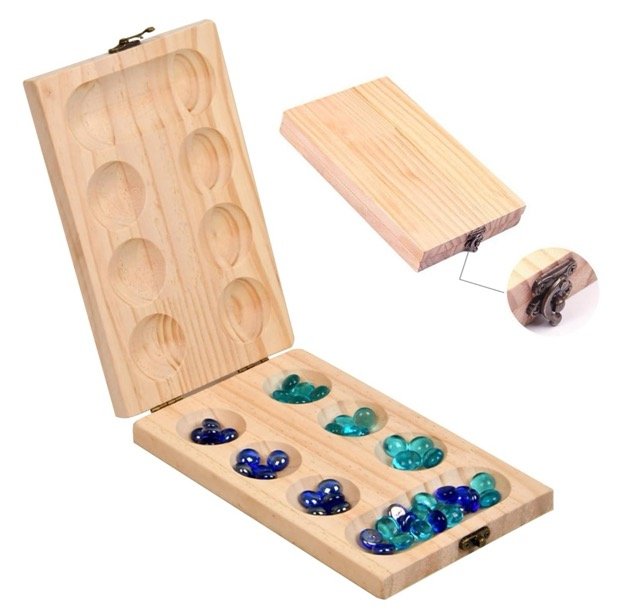
Mancala Zuniplex
- Folding wooden board with hinge: closes like a box and stores the pieces inside.
- Includes 48 coloured pieces.
Mancala DE LUXE
It is a board made from a single piece of solid wood (44 cm), carved with motifs that recall the game’s origins and —what we like most— with real quartz stones, no plastic or resin: one of the few that come with natural stone. That said, it is not the most portable: it weighs a fair bit and doesn’t fold, so think of it more as the pretty Mancala for the shelf than a travel companion. And note, it is rather compact: the stones are small (about 10 mm), comfortable but nothing huge.
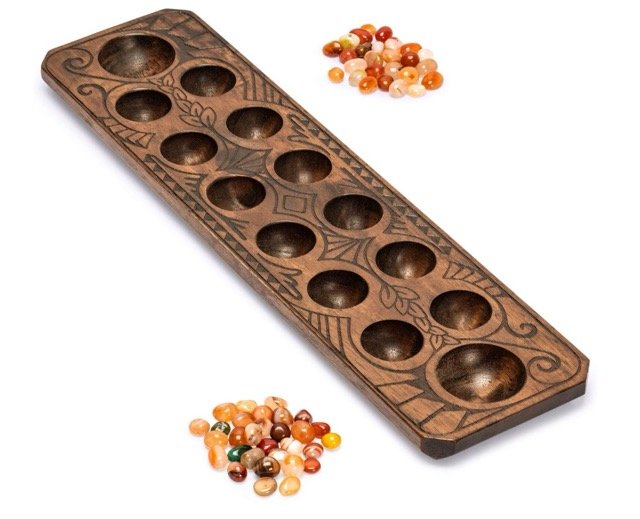
Yellow Mountain mancala board
- Solid wood, single carved piece · 44 × 11.5 × 2.5 cm.
- 48 coloured quartz pebbles (real stone, ~10 mm), not resin.
- For home: pretty and sturdy, but it doesn’t fold and isn’t for travel.
Games like Mancala
Oware (Abapa) can be played with the same board as Mancala. Although the stores do not participate in the capture of pieces, they can be used to store the pieces won. We encourage you to try it. The rules for capturing pieces are different.
Sungka is a game that extends the rules and game dynamics of Mancala. The games are longer and at some point more fun 😉
And we finish with a video in which you can see two girls doing moves from the game.