


How to play ROUND THE CLOCK
Set up

Players
Round the clock is a darts game for 2 to 8 players. They play all against each other.

What you need to play
A standard dartboard -with sectors and rings- and three darts are required.

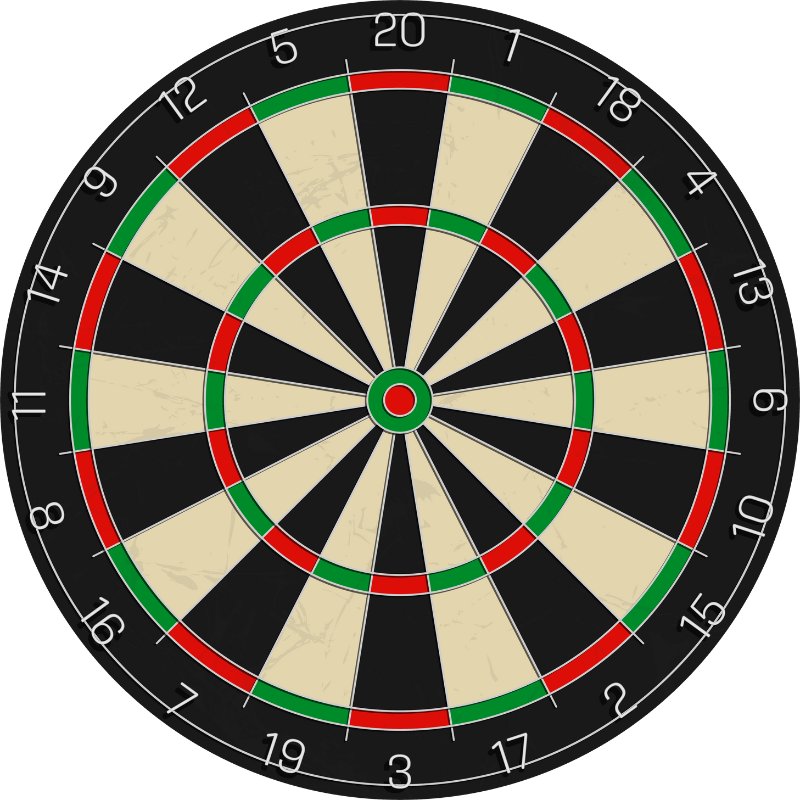
On this page we focus on “Round the clock” darts game rules. For general information about dartboards -sector meanings, doubles and triples rings, scoring system, hanging height, throwing distance…- visit the 301 dart game.

Who’s first?
Each player makes a throw at the dartboard. The player with the highest number of points plays first, the player with the second highest score plays second, and so on. Doubles and triples count.
Goal of the game

What do you need to do to win?
The goal is to hit a dart in each sector of the dartboard in a certain order.
“Round the clock” rules: playing a game
One turn = 3 darts
Each player throws three darts in turn. After three throws, you must pass the turn to the next player.
Turn after turn, each player must complete the objectives explained below.

First a double
The first objective for each player is to achieve a double, that is, to stick a dart in the outer ring colored green and red. It doesn’t matter in which sector it is achieved.
Then from 1 to 20
Once the double has been achieved, the next objective is to stick a dart in the sector 1. When it is achieved, the next goal will be the sector 2. Then the sector 3. And so on.
What are dartboard sectors?
In this picture we have shaded sector 4.


If it falls on a crown
Rings are valid. If the goal is, for example, sector 12, and the dart lands on the piece of the crown of doubles or triples in sector 12, the goal is considered to be achieved.
Darts out
If a dart goes out and is not stuck in the target, the throw is not repeated. That dart doesn’t count.
Bouncing darts
If a dart rebounds after hitting the dartboard and falls to the ground, the throw is not repeated. This dart is not counted.
Game over – who takes the crown??

And the winner is…
The game ends when a player successfully hits a dart in sector 20, becoming the winner. Congratulations!

Buying guide and tips
Here’s a quick guide to help you choose the perfect target for you.
Types of Dartboards
Paper or pressed cardboard targets
- Advantages: They are very cheap and hang easily.
- Disadvantages: The dart holes do not close. They are dartboards for casual use, almost single use.
Sisal or Bristle targets
- Advantages: They are made of natural pressed sisal fibers. They are preferred by many professional players due to their durability and ability to self-repair, that is, to close the holes left by the darts.
- Disadvantages: They are more expensive than other options. But if you want quality and durability, we recommend investing the money.
These targets require metal-tipped darts. Important.
Electronic Targets
- Advantages: Perfect for casual gamers. They automatically record the score and often have integrated games.
- Drawbacks: Some purists may argue that they do not offer the same feel as traditional dartboards, and sometimes may not register darts correctly. They require batteries or electricity, which is an added cost.
For electronic dartboards, plastic-tipped darts should be used.
Best Sellers on Amazon
Curious about the best-selling dartboards on Amazon?
Top ventas en dianas de sisal
Top ventas en dianas electrónicas
Top ventas en dardos de acero
Top ventas en dardos de plástico
And that’s a wrap – not too shabby, right?
Actually, one last thing… Check out the official rules used in international tournaments organized by the World Darts Federation. In case you want to go deeper.
Thanks for reading! Have a great day – and an even better night 😉